
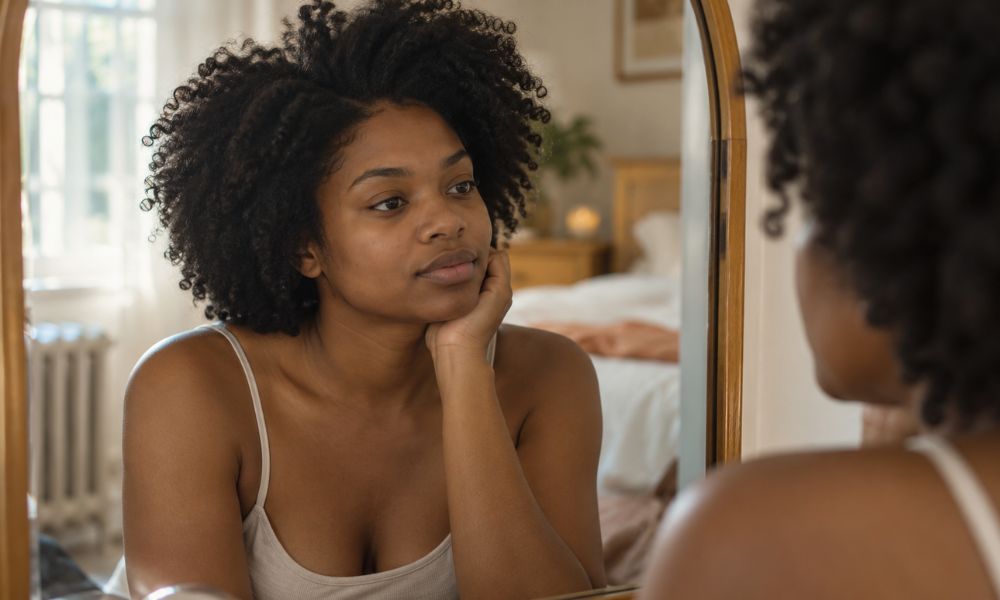
Black hair and beauty standards found me long before I had the words for them. The smell of hot comb and Vaseline belongs to my granny’s kitchen, not my mum’s. I was six, maybe seven, sat on a chair pulled up next to the cooker (that’s where the hot comb got hot), getting my hair pressed for church, buzzing with the kind of happiness only a child having her hair “done” properly really understands.
My aunties did the pressing for church, for parties, whatever the occasion called for. Some of them were barely five years older than me, sitting right there getting theirs done too, all of us in that kitchen together. There was a belonging in it. A whole family dressed the same way, for the same reasons.

Yet my mum never straightened her hair after she had me. She wore it natural before it was a hashtag, before it was a “movement,” back when it was just what a Rastafarian woman did because Babylon’s mirror was never one she agreed to look into. She didn’t own a lipstick. I never once saw her pluck an eyebrow. The music in our house was deep roots reggae (Culture, Burning Spear), songs that named the Atlantic slave trade plainly, the lyrics “we are captive down here,” no metaphor needed because the history didn’t need dressing up. It’s a little more complicated than one household and one standard. It always is.
European beauty standards show up in more places than one. Facial features. Skin colour. Body shape. All of it. But for me, the place it landed hardest, the place that actually left marks, was my hair. So that’s the story this piece tells. Not the whole map of it, just the one road I know best.

So how did I end up here? Relaxer burns on my scalp at 13. Weaves bought with my own pocket money by fifteen. A teenage habit of measuring how straight my hair looked against everyone else’s and doing the maths on what it would take to keep it that way.
I had the antidote at home. How did the poison still get in?
That’s the part nobody prepares you for. You assume protection is transferable. You assume if the adult in the room has already done the work of rejecting a standard, the child absorbs the rejection along with everything else, the way you absorb a language, or a way of holding a fork. But standards of beauty don’t work like inheritance. They work like weather. My mum could refuse to dress for it. She couldn’t stop it from raining on me, not when half my family was already standing out in it, kitchen table and hot comb, dressed for church every Sunday in hair nobody there was born with.
I want to be exact about what did this, because I think we get vague here in a way that lets everyone off the hook. It wasn’t “society,” floating and faceless. It was European beauty standards, doing exactly what they do, reaching a child in a Rastafarian household, past the reggae, past the natural hair, past a mum who had already fought and won that particular war for herself and planting the same seed anyway. That’s not a failure of my mum’s parenting. That’s a measure of how total the thing is. It doesn’t need your agreement. It just needs proximity.
You’d think growing up hearing “captive down here” every Saturday morning would make you immune to a magazine cover.
It didn’t. Because here’s the truth nobody says out loud: at that age you can’t actually articulate any of this yet and more importantly, you don’t want to. You’re not thinking about theory or history. You’re a teenager like every other teenager, chasing the latest fashion, the right music, thinking about boys, a way to fit in. The theory comes later. The hair damage comes now.
And there’s a part of this I won’t pretend away either. I loved some of what came out of those years. Relaxed hair gave me some of my favourite looks of my teens and twenties, styles lifted straight from the hip-hop and dancehall scene, not something I watched from the sidelines, I was at those parties, dressed for them, hair done to match. Complicated things can be true at the same time. The standard did its damage. I also had fun.
I’m not going to tell you I “unlearned” it and now I love every inch of myself and my hair because I don’t trust the neat before-and-after version of that story. What I have instead is the noticing that, as the natural hair movement becomes more and more visible, my own rejection is getting better, even if I’m not all the way there yet. I no longer relax my hair or reach for a straight weave, but I still won’t wear it out completely natural.
Honestly, there’s a version of natural Black hair I know I’m unlikely to ever wear, and I don’t fully know if that’s just my own taste or if it’s the number Eurocentric beauty standards have done to me. Sadly, I think it’s the latter. Still, I try not to beat myself up about it too much, and neither should you. Fighting European beauty standards on every single front is a huge task, and if you can’t take it on from every angle, that’s okay. We’ve got one life to live.
Both my mum and dad’s rejection of all this wasn’t wasted on me, even if it didn’t work the way any of us might have hoped. It gave me a place to stand while I worked it out, a household where I at least knew another way existed, even while I went my own way anyway. My mum’s only real pushback was ever a soft, “why are you straightening your hair, you’ve got lovely hair,” never more than that. I think that’s worth something.
Maybe most of what gets passed down between Black women isn’t immunity. It’s just a witness. Someone who already knows the shape of the thing you’re fighting, so you’re not out there thinking you invented your own confusion.

There might be something in just writing your own down. Not to fix anything, to see it clearly, in your own handwriting, where nobody’s editing you.
If you want somewhere to start, sit with these:
The first time I remember comparing my hair to someone else’s, I was…
The picture, film or person that first showed me what “good hair” was supposed to look like was…
The person who modelled a different way for me was…, and I did this with…
When I catch myself mid-reach for the thing I know I don’t believe in, what I actually need in that moment is…
If any of this is landing somewhere familiar, the Afro Woman Collection was made for exactly this kind of recognition not a fix, not a slogan, just something to hold that says I see what this cost, and I’m still here. Hoodies, jumpers, t-shirts, and an affirmation mug for the mornings that need one. You’ll find it at Samanthia Clarke Shop.