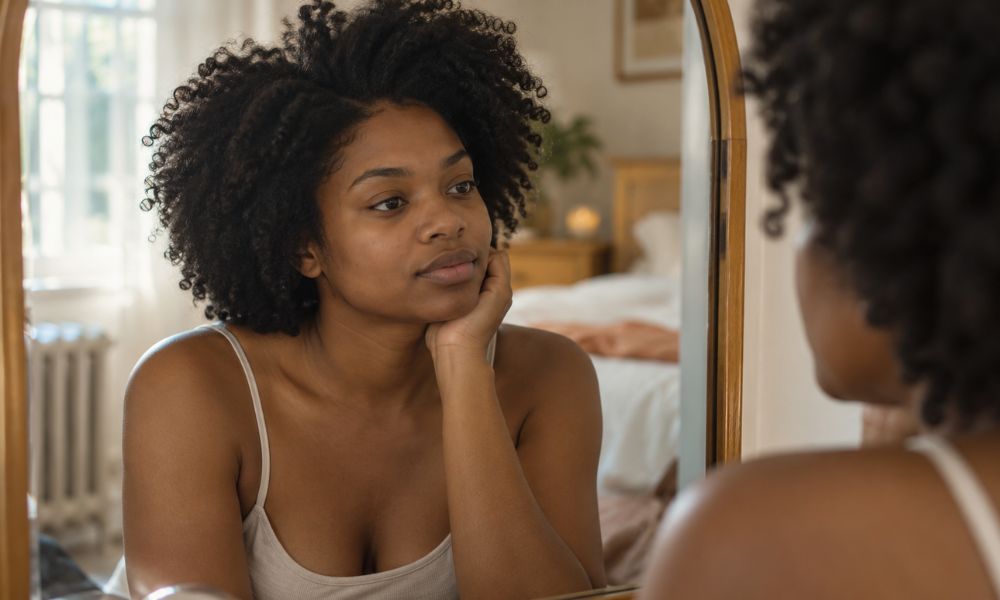
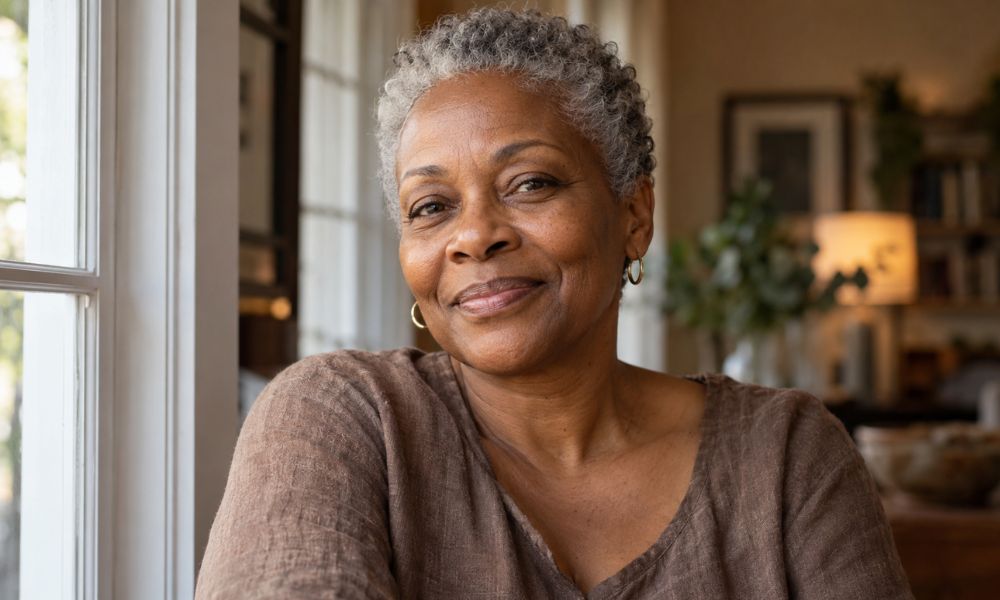
Every few months, a headline resurfaces. Some fifty-something actress, usually White, is praised for “ageing like fine wine,” her skin held up as proof that the right serum, the right regimen, the right discipline can outrun time itself. The comments fill with awe. The brand she’s fronting sells out.
Nobody asks the obvious question: why is the industry so obsessed with White women defying age and so silent about the group that’s been doing it for generations?
“Black don’t crack” is something said within Black communities. Not passed down so much as known, said by men and women alike, at kitchen tables, in barbershops, in hair salons.
Turns out it has more science behind it than most of us were ever told.

A review of decades of dermatological research on ethnic skin found that the visible signs of sun-related ageing (the fine lines, the wrinkling, the leatheriness) tend to be less severe and typically show up ten to twenty years later, in skin of colour, than in age-matched White skin (Vashi, de Castro Maymone and Kundu, 2016). Ten to twenty years. That’s not a subtle difference. That’s a decade, sometimes two, of a face simply not doing what the beauty industry insists every face eventually does.
The same review points to why. Some of it comes down to melanin, which absorbs and scatters UV radiation and offers real, measurable protection against the sun damage that drives premature ageing. But it isn’t only melanin. The researchers also found structural differences more numerous, more active fibroblasts and collagen that sits in tighter, more organised bundles (Vashi, de Castro Maymone and Kundu, 2016). Both contribute to skin holding its shape and structural integrity for longer. The full review is freely available and worth reading in its entirety see Aging Differences in Ethnic Skin on PubMed Central.
Then there’s the population data, which is the part I find hardest to look away from. A multinational study asked 3,267 women across the US, Canada, the UK and Australia to assess their own facial ageing against photographic rating scales (Alexis et al., 2019). Black women reported the least severe facial ageing of any group studied, while White women reported the most. More than 30% of Black women in the study didn’t report moderate to severe facial ageing until they were sixty to seventy-nine years old. For White women, that same threshold arrived at forty to fifty-nine. The age bands were two decades apart.
We’ve been saying this to each other for generations. It turns out the research has been quietly saying it too.
So, where’s the campaign? Where’s the multi-million-pound skincare line built around any of this?
Actually, maybe that’s the wrong question.
It’s why an industry that can discuss collagen loss down to the molecule has made so little mainstream space for the fact that ageing doesn’t look the same on every face. Black skin doesn’t need to be presented as the ideal. It does, however, deserve to be part of the baseline knowledge.
And separate research suggests it’s not just a marketing gap. A survey of over 1,600 US women found that Black participants were significantly less likely than White participants to feel represented in the information available to them about preventing skin ageing (Callender et al., 2024). This wasn’t a case of Black women caring less. In that same study, the importance placed on preventing skin ageing was high across all racial and ethnic groups studied. The interest is there. The information built for us mostly isn’t. This gap in representation isn’t new. The hidden agenda behind beauty advertising has long shaped who gets seen and who gets overlooked.

The interesting question isn’t really whether the science exists. It does, and it’s been sitting in dermatology journals for years. The more interesting question is why a beauty industry this obsessed with ageing has made so little culturally visible of it. Making Black skin part of the baseline conversation would mean treating Black people not as a niche market or a diversity line launched every February, but simply as part of the standard from which beauty knowledge is built.
Instead, beauty, health, youth and desirability have continued to default overwhelmingly to whiteness, with everybody else too often positioned as the exception, the deviation, the “also available in.” That default to whiteness runs deeper than skincare. It’s the same pattern that shows up in how Eurocentric beauty standards have historically sidelined Black women.
And so “Black don’t crack” has largely remained a compliment people give each other in private, rather than a fact the industry has had to reckon with in public.

There’s a peculiar kind of invisibility in seeing something plainly in your own family and never seeing the wider culture name it. You grow up seeing your mother, your aunts, women in your family who are sixty and look forty-five, and nobody in a magazine ever explains why. You absorb it as a private thing, never a headline. Never research, or so it felt, until you go looking and discover the research was there all along, just never pointed in your direction.
I don’t think this is a call to arms. I don’t think it needs one. I think it’s simply worth noticing, properly noticing, the way you notice something you’ve walked past a thousand times and never really looked at. The industry’s silence isn’t neutral. Silence rarely is.
Of course, “Black don’t crack” doesn’t mean Black skin doesn’t age. It means it can age differently. That’s a conversation worth having in its own right and one for another day.
There’s a particular kind of pride in this for Black people, though. Not the loud, performative kind. Something steadier. The kind that doesn’t need external validation to be true, because it was true before anyone was paying attention and it’ll stay true after the industry catches up, if it ever does. And for those ready to put their money where that pride is, supporting Black-owned beauty brands is one way to make the quiet knowing a little louder.

If any of this landed somewhere for you, the Afro Woman Collection was made with exactly this kind of quiet knowing in mind: the hoodies, the jumper, the tee, the affirmation mug. Not slogans shouting for attention, just small, everyday reminders of what you already carry. You can find the collection at Samanthia Clarke Shop.
And if you want to sit with any of this a little longer, a few places you could start:
There’s no need to finish all of them today. Just let one sit and see what it stirs up.
Alexis, A.F., Grimes, P., Boyd, C., Downie, J., Drinkwater, A., Garcia, J.K. and Gallagher, C.J. (2019) ‘Racial and ethnic differences in self-assessed facial aging in women: results from a multinational study’, Dermatologic Surgery, 45(12).
Callender, V.D., Harvey, V.M., Hartman, C.L., Gohara, M., Khan, T.T., Kwan, W. and Ginn, L.R. (2024) ‘Do women with skin of color think they are well represented in skin aging prevention information?’, Journal of Clinical and Aesthetic Dermatology, 17(4), pp. 18-22.
Vashi, N.A., de Castro Maymone, M.B. and Kundu, R.V. (2016) ‘Aging differences in ethnic skin’, Journal of Clinical and Aesthetic Dermatology, 9(1), pp. 31-38.