There’s a version of getting better from anxiety that gets talked about a lot. The one where you do the work, find the right therapist, take the right steps, and then one day you wake up and you’re better. Lighter. Free.
That’s not quite how it goes.
What actually happens is quieter than that. And messier. And honestly, more interesting.
Prefer to listen?
Listen to the full article below.
For a lot of women, it arrives as something else entirely. Exhaustion. Irritability. A sense that you’re always just about to drop something. A constant low-level hum of what if that you’ve lived with for so long, you stopped noticing it was even there.
Is this just who I am? Or is this something I could actually change?
Research consistently shows that women are diagnosed with anxiety disorders at roughly twice the rate of men. But that statistic doesn’t tell the whole story. It doesn’t capture how differently anxiety tends to show up, and how differently it tends to get dismissed. Men’s anxiety often gets read as stress or anger. Women’s anxiety gets read as oversensitivity, hormones, or just personality. We internalise it. We manage around it. We become very, very good at functioning while quietly falling apart.
That competence is a kind of armour. It’s also part of why getting better takes longer than it should.
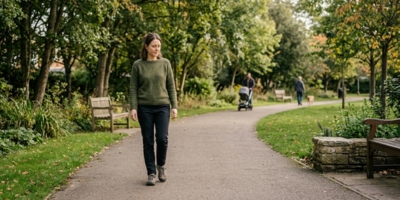
One of the things nobody tells you is that recovery isn’t a straight line. It’s not even really a line. It’s more like weather. Some days are clear. Some days the fog rolls back in and you think: have I actually changed at all? Or have I just been waiting for the next thing to knock me sideways?
I spent years managing anxiety that had taken a real physical toll on my body. Muscle tension, nerve symptoms, and eventually a full panic attack. At my worst, I couldn’t choose a sandwich at lunch without the decision sending me into a spiral. That’s not hyperbole. That was my reality.
The work I did, journaling, mantras, cognitive behavioural techniques, Alexander Technique, attending a spiritual movement, none of it produced a dramatic turning point. What it produced was something more like a shift in the floor beneath me. Small. Gradual. Barely perceptible, until one day I looked back and realised I was standing somewhere different.
The test of how far I’d come didn’t arrive quietly. It arrived as a police arrest, a Crown Court charge for racially aggravated criminal damage for something I hadn’t done, and nine hours in a cell with nothing but my own thoughts for company.
And I didn’t panic.
Not because I’d become someone who didn’t feel things. But because I’d done enough work that my feelings no longer had to run the show. I knew how to breathe. I knew how to slow my thoughts down. I had practised, enough times, the difference between fear and danger.
This is frightening. And I will get through it.
That’s what getting better actually looks like. Not the absence of hard things. The ability to meet them without dissolving.
For women, and particularly for Black women, there’s another dimension to this that sits underneath all the clinical language about anxiety.
We are often raised to be capable in the face of everything. To hold it together. To not burden others with what we’re carrying. Asking for help can feel like admitting weakness, especially in communities where strength has been both a survival strategy and a source of pride for generations.
If I fall apart, who holds everyone else together?
That question has real weight. It’s not irrational. It comes from somewhere. But it’s also one of the quieter ways anxiety keeps its grip, by convincing you that your distress matters less than your function.
Getting better, for a lot of women, starts with the uncomfortable act of believing that your inner life matters. That you are not just a vehicle for getting things done.
There isn’t one path. What worked for me won’t be the same as what works for you. But some things tend to be true across the board.
The work is usually slow and usually unglamorous. It’s a journal entry at 6am when you haven’t slept well. It’s a mantra you’ve said so many times it’s started to sound like your own voice. It’s choosing, on an ordinary Tuesday, not to let your thoughts run unsupervised.
It’s also about building something to lean on before you need it. The women I’ve seen move through anxiety most meaningfully aren’t the ones who found a single solution. They’re the ones who built a quiet infrastructure of techniques, practices, and people that held them when life did what life does.
Because life will do what life does. The test of your progress won’t come in a controlled environment. It’ll come at 5am, or in a courtroom, or in the middle of an ordinary conversation that suddenly isn’t ordinary anymore.
And when it does, you’ll find out what you’re made of. Not in the dramatic sense. In the quiet sense. In the sense of: I’ve been here before. I know what to do.
If any of this resonates, if you’re somewhere in the middle of the work and wondering whether it’s adding up to anything, the How Did I Get Here? journal was written for exactly that place. It’s for anyone sitting with anxiety that has roots, that has history, that needs more than a breathing exercise. You can find it at Samantha Clarke’s shop.
Writing isn’t a fix. But it is a way of slowing your thoughts down enough to see them clearly. If something in this piece stirred something in you, you might try putting it somewhere.
When I first started managing my anxiety instead of addressing it…
What I actually need, if I’m honest…
Something I handled recently that I haven’t given myself credit for…
The version of “getting better” I’ve been waiting for…
One small thing that has genuinely helped me, even just a little…