
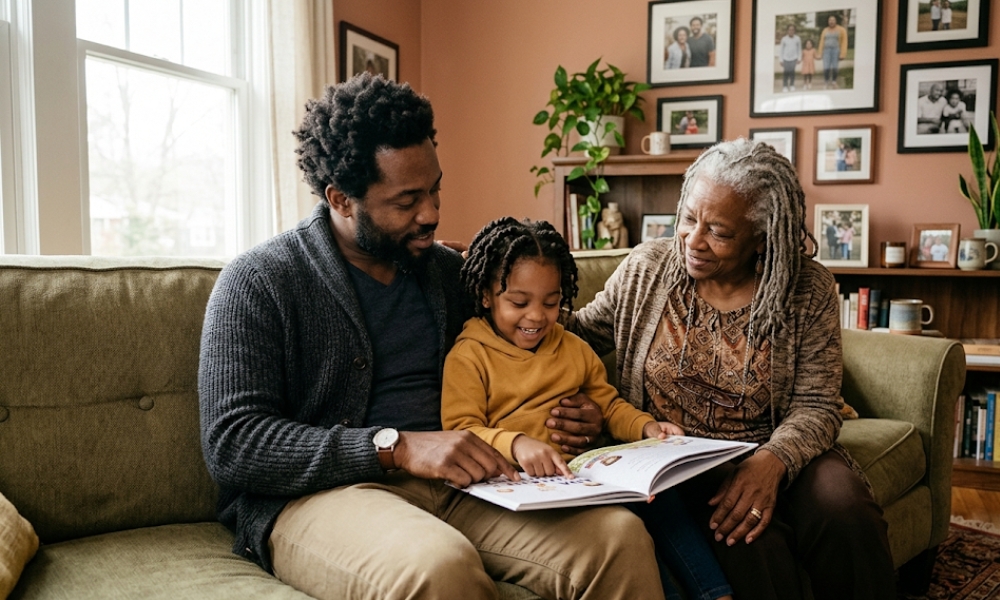
At some point in your parenting journey, you might start to notice something. The questions you’re turning over — how do I raise a child who knows their own worth? How do I help them bounce back when things get hard? — aren’t new questions. They’ve been asked before. Answered before. With real care and real depth, long before any of us got here. This is where ancestral wisdom in parenting begins to matter.
The people who did that work were your ancestors.
Prefer to listen?
Listen to the full article below.
African philosophy has always understood something that the Western world tends to forget: a person doesn’t exist on their own. The individual and the community are bound together. That idea — simple as it sounds — holds an entire approach to parenting within it.
Ubuntu. I am because we are.
This isn’t a quote for a mood board. It’s a framework for living. It says that a child doesn’t grow in isolation. That who they become is shaped by who surrounds them. That the village — the extended family, the neighbours, the elders, the wider community — isn’t a bonus. It’s a necessity. And the responsibility of raising that child belongs to all of them.
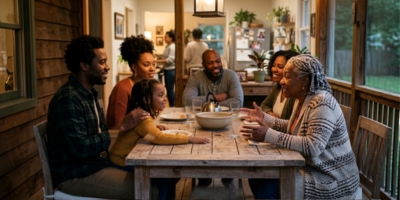
In practice, this meant children who could be guided by any trusted adult who saw them — not just their parents. Who learned respect not because it was demanded, but because it was demonstrated, everywhere, all the time. Who grew up understanding, from early, that they were part of something bigger than themselves.
That’s not a small thing to give a child.
There’s a Ghanaian proverb that says:
A child who is not embraced by the village will burn it down to feel its warmth.
Read that once. Then read it again.
Because what it describes — a child left without belonging, without being seen and held by their community — isn’t a problem from the past. It’s one that shows up now, in different forms, in different places. The wisdom isn’t old. It’s just been set aside.
Much of what African ancestral culture understood about children started from one core belief: a child arrives with spirit, with purpose, and with dignity that exists before any mistake they might ever make.
Discipline, from this view, was never about crushing a child’s will. It was about bringing them back to themselves. Back to the values of the community. Back to who they already were.
There’s something else worth holding onto. African cultures were — and in many places still are — rooted in oral tradition. Stories, proverbs, songs. These were how wisdom travelled. Not through textbooks. Through people.
Elders sat with children and talked. They told the stories that carried the community’s values inside them. They made wisdom something that could be heard, felt, and remembered.
There’s a proverb from across West Africa:
Knowledge is like a garden: if it is not cultivated, it cannot be harvested.
It speaks to how deliberate the passing down of wisdom was. It didn’t just happen. It was tended. Given time, attention, and repetition — because the elders understood that what a child learns, and how they learn it, shapes not just that child but the generation that follows them.
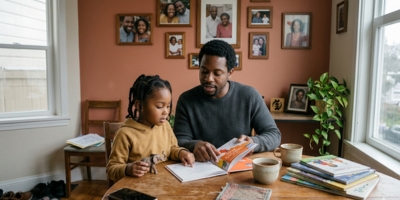
In a time when so much of children’s education is handed over to screens and institutions, there’s something worth reclaiming in the act of sitting with a child and telling them who they come from. What your people believed. What mattered to them. What they thought was worth protecting.
That conversation doesn’t need a curriculum. It just needs intention.

Caribbean parents — many of them descendants of Africans forcibly cut off from their cultures — carried pieces of this wisdom across the Atlantic, often without realising that’s what they were doing.
The deep respect for elders. The expectation that children would play their part in the home. The understanding that a child’s behaviour reflected on the whole family. The proverbs that survived the crossing, adapted and translated, still passing through front rooms and around dinner tables.
Manners carry you through the world.
Honour your mother and your father.
What you do in the dark will come to light.
These weren’t just rules. They were the remnants of something older and more considered — a whole understanding of what it means to raise a person with integrity, inside a community that depends on that integrity to work.
The invitation here isn’t to romanticise the past, or to pretend that ancestral cultures were without their complications. They weren’t.
But there’s a difference between blind reverence and genuine reclamation. Genuine reclamation means looking honestly at what your ancestors understood — about children, about community, about the long arc of who a person becomes — and asking what still holds.
Most of it still holds.
A child who knows they come from a people of wisdom carries themselves differently. Not with arrogance. With rootedness.
And a rooted child is much harder to shake than one who has been cut off from their own story.
That’s the gift. It was always there. It’s worth picking back up.
If this has stirred something in you — if you find yourself wanting to sit with where you came from and what you want to carry forward — the Self-Reflection Journal for Black Parents at samanthiaclarke shop was made for exactly this kind of thinking.
A space to reflect, not just on the parent you’re becoming, but on the lineage you’re part of.
Writing is one of the ways we start to understand what we actually believe, as opposed to what we’ve simply absorbed. If any part of this resonated, it might be worth sitting down and seeing what comes up when you write.
There are no wrong answers. Just yours.