There’s a particular kind of tired that doesn’t come from your own life.
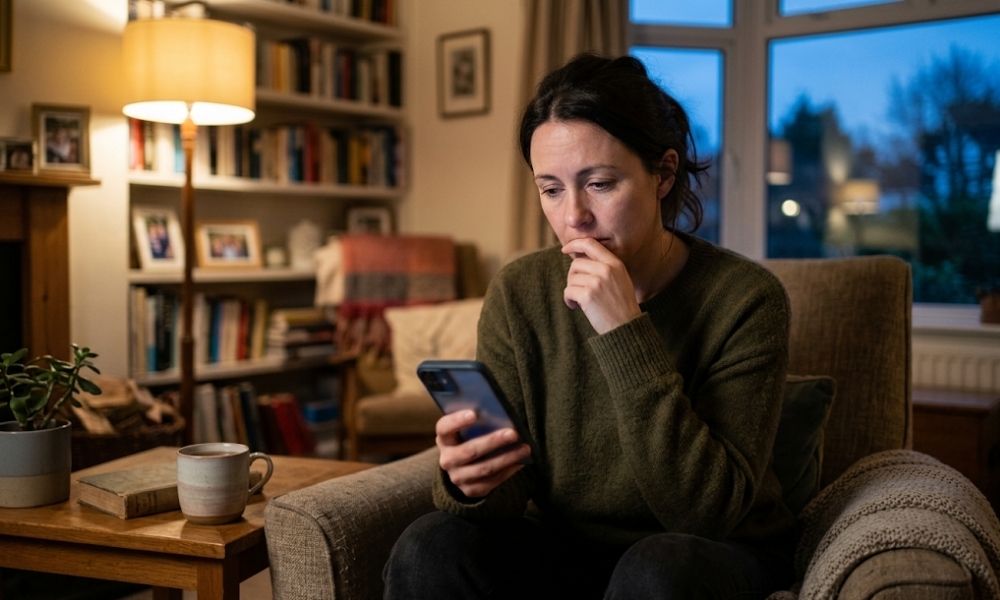
You didn’t lose anyone. You weren’t there. And yet you scroll through the news, and something in your chest tightens anyway.
You close the app, then open it again ten minutes later because some part of you can’t stop checking.
Prefer to listen? Hit play below.
You tell yourself:
“I’m fine. I’ve got my own things going on. This isn’t even my tragedy. I have enough of my own to carry. So why can’t I put the phone down?”
There is a name for what you’re feeling.
It’s called collective trauma.
Collective trauma is a wound that doesn’t stay limited to the people who directly experienced an event.
It spreads through communities, generations, and sometimes across the entire world.
It doesn’t ask permission before it reaches you. It doesn’t require you to have been physically present.
We often think of trauma as something private — something that happens to an individual, something they carry and process in isolation.
That understanding isn’t wrong.
But it was never designed to hold everything.

Covid.
Grenfell.
The list continues to grow.
Each event leaves behind something that extends beyond the people who were directly there.
After 9/11, an entire generation changed how it moved through airports and cities.
During COVID, the whole world learned to feel uneasy at the sound of a cough.
And today, millions of people are watching suffering unfold in real time through the same phones they use for everyday life.
That collision — horror existing beside ordinary routines — creates its own kind of emotional burden.
This is collective trauma doing what it does.
It settles into people who were never physically near the event.
“I should be able to compartmentalise this better than I am. Everyone else seems to be getting on with their day.”
This is usually when guilt appears.
It disguises itself as logic.
It tells us there is a correct amount of emotion we should have.
That continuing with normal life means something is wrong with us.
But feeling affected does not mean your nervous system is failing.
It means it is responding.
Humans were never built to witness suffering from a safe distance and feel nothing.
We are wired for connection.
When you see a child pulled from rubble or watch a hospital line stretch around a block, some deep part of your nervous system reacts.
Because throughout most of human history, there was no clear separation between “us” and “them.”
The suffering of people nearby affected the entire community.
That wiring has not disappeared.
We have simply created a world where we are exposed to suffering constantly, while being expected to process it alone.
This is what quietly wears people down.
Not only the events themselves.
But the loneliness of trying to process something enormous with tools designed for individual problems.
A breathing exercise can help.
But it was never designed to carry the weight of a pandemic, genocide, or years of repeated public tragedy.
When the wound is collective — shared, historical, and structural — but the healing process is entirely individual, something feels incomplete.
We end up managing our own nervous systems alone for a pain that was never meant to be carried alone.

Many people who work in trauma and healing have argued that some wounds cannot be repaired behind closed doors.
Throughout history, humans did not process grief privately.
They did it together.
Through community.
Through rituals.
Through shared experiences.
Through the presence of people who could hold what one person alone could not.
Community was not simply comforting.
It was part of the healing process itself.
This raises an uncomfortable question in cultures built around individual responsibility:
What happens when the pain is larger than the space where we are expected to heal?
There is no simple answer.
There is no single exercise that can make collective grief disappear.
Some things remain unresolved — within individuals, communities, and entire societies.
We are still learning how to hold grief that belongs to no single person but somehow belongs to everyone.
The tightness in your chest when you close the app is not a sign that something is wrong with you.
It is not oversensitivity.
It is your nervous system responding exactly as it was built to respond.
The challenge is that we now live in a world that gives us more suffering to witness than humans were ever designed to absorb.
For feelings that do not have a single clear origin, writing can become a place to begin.
Not to solve everything.

Not to force an answer.
Just to move the feeling from inside your body onto a page, where it can become easier to understand.
A few sentences to begin:
I made the How Did I Get Here? journal for the kind of anxiety that doesn’t have a single, tidy origin; the kind with roots that stretch further back than your own life, into things you witnessed and absorbed and never quite put down. It isn’t asking you to explain the feeling or resolve it in one sitting. It’s just somewhere to start putting it into words. You can find it at Samanthia Clarke’s Shop.
Sometimes the most honest thing you can do with a feeling that feels too large is acknowledge it.
Write it down.
Share it.
Allow it to exist.
Not because you need to fix it immediately.
But because some things become lighter when they are no longer carried alone.