Something real has been happening in the beauty industry. Over the last decade or so, Black women-owned beauty brands and Black-owned beauty brands have been building products that actually understand our skin, our hair, and our long history of being ignored or badly served by the mainstream.
Products formulated with us as the starting point, not an afterthought. Founders who know what it means to be told, directly or indirectly, that your features are a problem to be corrected.
And slowly, then quickly, some of those brands have started to get the recognition they deserve. Shelf space. Press coverage. A seat at tables they were never invited to before.
I’m not going to pretend that isn’t meaningful. It is. But I’d be doing you a disservice if I left it there, because that’s also exactly the moment we need to pay close attention.
Prefer to listen?
Listen to the full article below.
Here’s the thing about progress: it can make you feel like the hard part is over. Like the momentum will carry itself now. Like you can breathe out.
I understand that feeling. I really do. When you’ve watched something you care about struggle for years and then start to win, of course you want to exhale. You’ve earned that.
But white supremacy doesn’t issue a press release when it decides to adapt. It doesn’t hold a conference and announce that things are changing. What it does, what it has always done, is recalibrate. Quietly. In the structures that are harder to see and easier to overlook when things feel better than they used to.
In the beauty industry, that looks less like open hostility and more like: which founders get the funding. Which products get placed at eye level. Which aesthetics get called “clean” or “minimal” or “premium” and which ones don’t.
It also shows up in which brands get acquired, and more importantly, what happens to them afterwards. Who ends up in the boardroom when a Black-owned business becomes profitable enough for larger companies to notice.
Visibility and ownership are not the same thing. Being celebrated and being protected are not the same thing. And I think, if we’re honest, many of us sense that, even when we can’t always say exactly why.
I keep buying from her because I know how hard she worked to build this. But I noticed the formula changed after that last round of investment. I can’t prove anything. I just notice.
The brand blew up and now everyone’s buying it. Which is great. Except now I can’t help feeling like, is this still ours?
These aren’t small thoughts. They’re what pattern recognition looks like when you’ve been paying attention for long enough.
There’s another layer to this that I think we don’t talk about quite enough.
What we choose to put on our bodies isn’t just a purchasing decision. For generations, Black women were sold products designed to bring us closer to a European standard of beauty. To lighten. To straighten. To minimise.
The message running through all of it, whether anyone said it out loud or not, was that you were too much of some things and not enough of others. That you needed adjusting.
That doesn’t disappear because the shelves look different now. It takes time, real time and real intention, to fully unhear something you were taught about yourself before you even had the language to question it.

Black beauty brands, the ones built by women who lived this, tend to operate from a completely different premise.
Not “here’s how to fix yourself” but “here’s something made for exactly who you already are.”
That’s not a small thing. That’s a fundamentally different relationship between a product and the person using it.
So when we support those brands, we’re not just doing something economic, though that matters too. We’re also participating in a different story about who we are and what we’re worth. And that story needs to keep being told. It doesn’t become permanent after one chapter.
I’m not saying any of this to make buying a moisturiser feel like a political act you have to perform correctly. That’s not what this is about.
What I am saying is that complacency is a risk. Not because we’re not trying hard enough, but because real, visible progress naturally creates the feeling that the pressure is off.
And when the pressure comes off, attention drifts. And when attention drifts, things can quietly move backwards without anyone making a decision to let them.
The brands that are still founder-led. The ones that are still independent. The ones that haven’t yet had the luxury of a safety net if one product launch doesn’t land, those brands cannot afford for our attention to drift.
They built for us. On very little. And they are still building.
We’re not at the finish line. I know it can feel that way sometimes, and I understand why. But if we’re honest, we know the work isn’t done.
The question is whether we’re going to stay awake to that, or wake up in five years and wonder how we ended up back where we started.
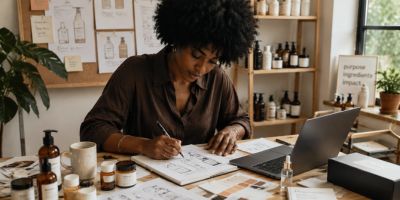
Conversations about beauty always seem to come back to the same question: how do we define ourselves beyond what we’ve been told we should look like?
That question is also what sits at the heart of my Afro Woman collection, hoodies, tees, a jumper and a mug, each carrying affirmation messages designed around confidence, identity and self-expression.
Not as a statement to anyone else. As a quiet daily reminder to yourself.
I’ll leave it there, because I don’t think this is something that gets resolved in a blog post. It’s something worth sitting with privately, honestly, without the pressure of anyone else’s opinion in the room.
If any of this has stirred something in you, even just a thought you’ve had before but never fully followed, I’d encourage you to write it down. Not for anyone else. Just for you.
Sometimes what we actually think is buried just below what we feel we’re supposed to think, and writing is one of the better tools I know for getting at the difference.