
At some point, without anyone asking your opinion, a decision was made. A decision shaped by beauty standards about what a woman’s body should look like. How much space it should take up. Where it should be narrow, where it should curve, what it should weigh, and how it should age.
That decision has been revised many times over the centuries. It will be revised again. And yet somehow, each version presents itself as the final word. As objective truth. As just… the way things are.
It isn’t. It never was.
The ideal female body is not a fact. It is a construction. And like all constructions, somebody built it with particular materials, in a particular place, with particular interests in mind.
Prefer to listen?
Listen to the full article below.
The body ideal that dominates global advertising, mainstream media and the fashion industry today is, at its core, a Eurocentric one. Slim but not too slim. Toned but not too muscular. Tall, symmetrical, light-skinned. Young, or appearing young. Narrow hips that somehow also accommodate curves in precisely the right places — an increasingly digitally manufactured combination that has never existed in nature at the rate we’re now expected to aspire to it.
This standard didn’t appear from nowhere. It was exported through colonialism, through Hollywood, through fashion weeks and glossy magazines, into every corner of the world. And it arrived with authority. With the implicit message that this was not just one aesthetic among many, but the aesthetic. The one that conferred value. The one worth aspiring to.
If I could just lose a bit more weight.
If my waist were smaller.
If I looked more like
The sentence doesn’t even need finishing. Most women know exactly how it ends.
The Eurocentric ideal has never been the whole story. It has simply been the loudest voice in the room. And in cultures around the world, despite the noise, a very different relationship with the female body has persisted.
In many West African cultures and across much of the Caribbean, a fuller, rounder body has long been associated with health, fertility, prosperity and beauty. Width in the hips, softness in the belly, substance in the thighs — these are not imperfections to be corrected. They are signs that a woman is well, that she is thriving. The pressure to be thin that runs through Western culture does not carry the same weight here. Quite literally, weight itself carries different meaning.
Across India, Pakistan, Bangladesh and Sri Lanka, the beauty ideal has historically included curves, softness, and a fuller figure, seen as signs of femininity, good health, and abundance. Fair skin has long been prized, which is its own complicated and painful conversation. But the ultra-thin ideal of Western fashion has always sat uneasily alongside a cultural aesthetic that values roundness and softness in the female form. Bollywood has shifted somewhat toward a slimmer look in recent decades, but traditional beauty standards persist strongly at community level.
In Fiji, Samoa, Tonga and across much of Polynesia, larger bodies have historically been celebrated as signs of strength, status, and beauty. Research into body image in these communities has consistently found lower rates of body dissatisfaction than in Western populations, though this is changing as Western media spreads further, which is its own troubling indicator of where the damage comes from.
In parts of Mauritania, the practice known as leblouh, the deliberate fattening of young girls to make them more marriageable, reflects a beauty ideal in which a large body signals wealth and desirability. It is a tradition with its own complex ethical dimensions, but it stands as one of the clearest illustrations of just how culturally constructed and geographically specific the concept of the ideal body truly is.
The beauty ideal across much of Latin America includes and celebrates curves, particularly in the hips and buttocks, in ways that sit quite differently from Northern European aesthetics. The curvy ideal here is not a reluctant accommodation; it is the standard. And while skin tone ideals vary and carry their own hierarchies, the body shape itself is celebrated in a way that mainstream Western fashion has only recently, and somewhat awkwardly, begun to acknowledge.

There has been a visible shift in Western media and advertising over the past decade. More body diversity on runways. More size inclusivity in campaigns. The rise of the curve ideal, the celebration of the fuller figure in mainstream pop culture.
It would be easy to read this as progress. And in some ways it is.
But it’s worth asking who is defining this new standard, and on what terms. Because a new ideal is still an ideal. And the message, this is what is beautiful now, this shape, this proportion, still positions women’s bodies as objects to be assessed, approved, and ranked.
Am I the right kind of curvy?
Is this the acceptable version of bigger?
The goalposts shift. The game stays the same.
The real work, the harder, quieter, more personal work, is not finding a beauty standard that includes you. It’s questioning why you need a standard at all.
Your body is not a project. It is not a problem to be solved or a canvas to be adjusted until it meets an external specification. It is the thing that carried you through every experience you have ever had. It has absorbed grief and expressed joy and held other people and kept you alive through things you weren’t sure you’d survive.
It does not need to look a particular way to deserve care. To deserve clothing that fits beautifully. To deserve to take up space without apology.
Somebody decided what the perfect body looks like. They consulted their own interests, their own cultural moment, their own idea of what women are for.
You were not in the room. You don’t have to live by the outcome.
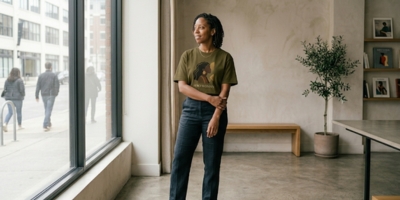
If you’re a Black woman who is done performing smallness, in your body, in your presence, in the space you take up, the Afro Woman Collection at samanthiaclarke was made with you in mind. Hoodies, jumpers, t-shirts, and an affirmation mug, pieces that wear like a quiet statement. Not a slogan. Just a reminder of who you are.
Writing about your own relationship with your body, not to fix it, not to set goals, just to witness it honestly, can be surprisingly revealing. What stories have you absorbed? Where did they come from? What would you think about your body if nobody had ever told you what to think?
You don’t have to answer those questions out loud. But they’re worth sitting with.