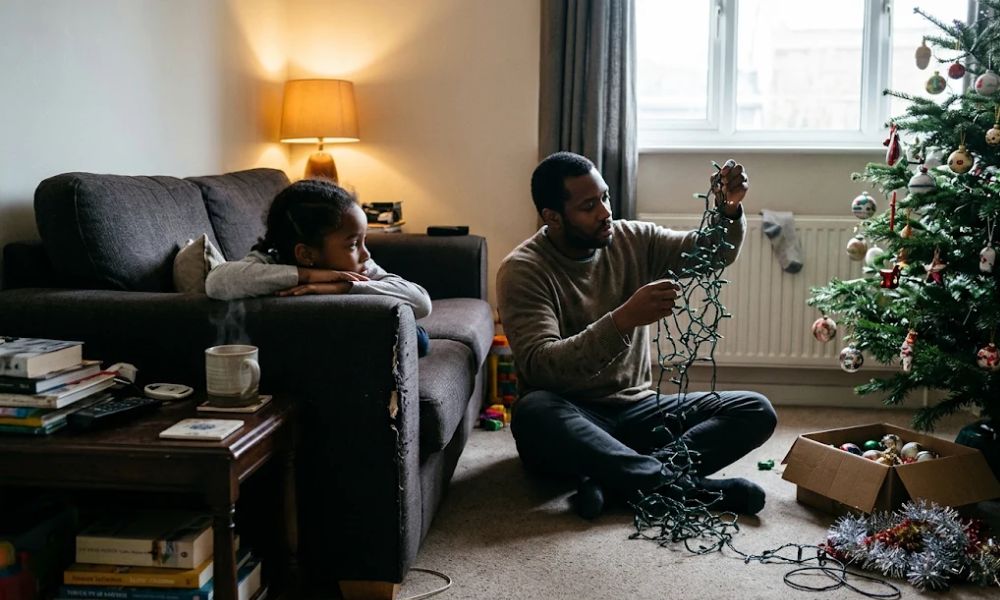
The Christmas memories children remember are rarely the ones we planned. They live in the small, unguarded moments like this one.
Somewhere behind the sofa, a seven-year-old is lying very still, chin on her folded arms, watching her father lose a quiet battle with the fairy lights. He mutters. He holds the knot up to the window as if daylight might make it confess. Music drifts in from the kitchen, where her mother is singing along to an old R&B slow jam, getting the words wrong, and nobody minds. The radiator ticks. The whole room smells of pine from the real tree, a little rum from somebody’s glass, and a mac and cheese in the oven that needs another hour.
Nobody is looking at her. She is taking all of it in.
Meanwhile, the grown-ups are busy. There’s a list on the fridge and a second list in someone’s phone. The good tablecloth has been ironed, the matching pyjamas ordered, the advent calendar filled. Parents, grandparents, aunties, uncles, the older cousin put in charge of the little ones we all carry a picture of the Christmas morning we’re aiming for. The gasp, the wide eyes, the moment we’d love to freeze.
And it’s lovely. All of it is an act of love. Wanting to make something magical for a child is one of the nicest instincts a family has.

This is the one they’ll remember. Possibly. Children do remember some of it. But memory is a curious editor. It rarely keeps what we staged. It keeps whatever it happened to be standing next to.
Ask an adult what they remember of their childhood Christmases and notice how seldom the presents come up. What comes up is smaller and odder. Dad asleep in the armchair with a paper hat sliding down his forehead. The sorrel that only appeared in December. The particular way an auntie said your name as she came through the door. Being allowed to stay up late, and nobody ever saying why.
Children are collecting the same material right now, in our living rooms, and they’re very good at it. They take in the mood of the house before anyone has said a word. They notice who laughs in the kitchen. They notice a granddaughter handing her grandma the first plate, an uncle warming his hands round a mug while a cousin tells the same story for the fourth year running. They notice how the adults speak to each other when the day is busy and how gentle everyone can be when something goes slightly wrong.
Oh no, the sorrel’s gone all over the tablecloth.
Then it’s had a proper Christmas now. Pass me the salt.
That’s the memory. A child hears a household that can spill something red on the good tablecloth and answer with a joke and files it somewhere deep under this is what home sounds like.
Nobody planned it. That’s what makes it so good.

Children keep the harder moments too, and it’s worth saying so gently. Not every Christmas memory is warm. Some are a raised voice over the washing-up, an uncle who has had one too many, money worries nobody mentioned, but everybody felt, a chair that’s empty this year. Children rarely hold on to the details. They hold on to the feeling, the tightening, the sudden quiet, the sense that it’s best to keep out of the way.
That isn’t a reason for alarm. Most of us carry a difficult Christmas from our own childhood, and we turned out loving. It’s simply useful to know that a child reads the feeling in the room more than the words. And that works in our favour too. The apology after the row, the extra hug for the child who went quiet, the story told about the person no longer at the table those get remembered as well.
As developmental research from the Harvard Center on the Developing Child highlights, resilience in children is built not by avoiding hardship, but through supportive, stable relationships that buffer stress. Furthermore, guidance from the Child Mind Institute on emotional repair demonstrates that how adults reconnect and apologize after a moment of tension teaches children that relationships can safely weather conflict. Repair is a memory in its own right.

Many of us grew up with Christmases that were less about the schedule and more about the gathering. A pot of rice and peas, or jollof, that took all day. Black cake soaking in rum for weeks. Reggae, soca and R&B turned up loud enough to count as a conversation. Too many people in too small a room, someone’s elbow in someone’s curry goat and an elder holding court from the best chair. Nobody called any of it a tradition. It was simply what happened, so we never noticed we were being given something.
Now we’re the grown-ups, quietly working out how to hand the children in our lives something just as warm. Perhaps it helps to remember that what we received was never really the food or the decorations. It was the feeling of being among people who belonged to each other and were glad of it. We can’t stage that. We can only be in it and let them see.
So, the lights may stay tangled for another hour. The pyjamas may not quite match. The photograph may be slightly blurry, with someone’s thumb in the corner. There’s a lot of room in that. That’s rather a relief.

If you’d like somewhere to hold both the hard days and the happy ones, I made the Self-Reflection Journal for Black Parents for exactly that. It helps you work through the challenges of parenting and includes a section just for reflecting on the joy of your child or children.
Writing is a gentle way of catching these moments before they slip past. A few lines at the end of a December evening are plenty. If you’d like somewhere to start, try finishing any of these sentences:
Behind the sofa, the seven-year-old shifts and the lights finally blink on. Her father cheers as if he’s won something. She smiles into her folded arms, stays very still so she won’t be noticed, and keeps all of it.