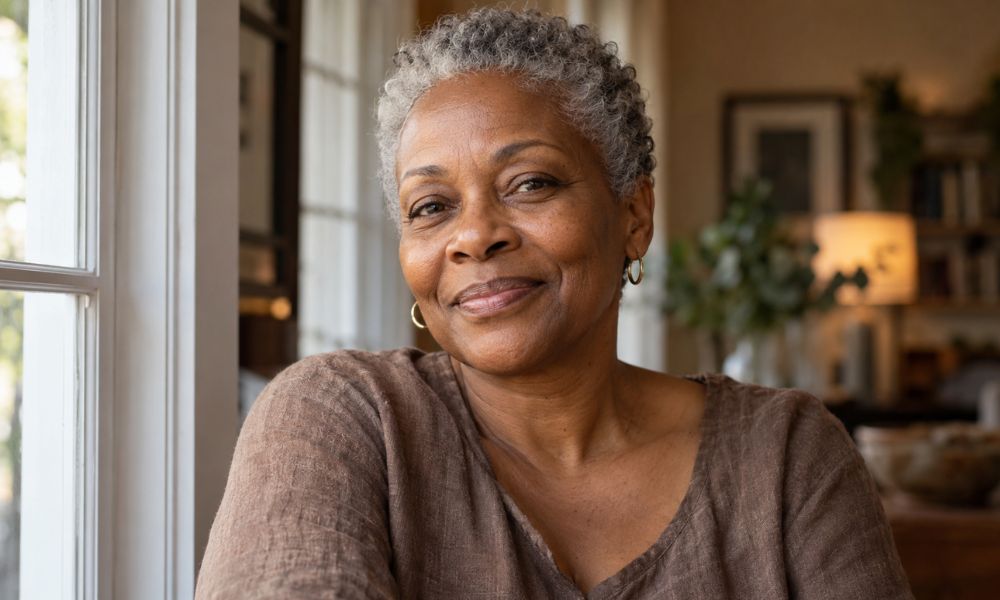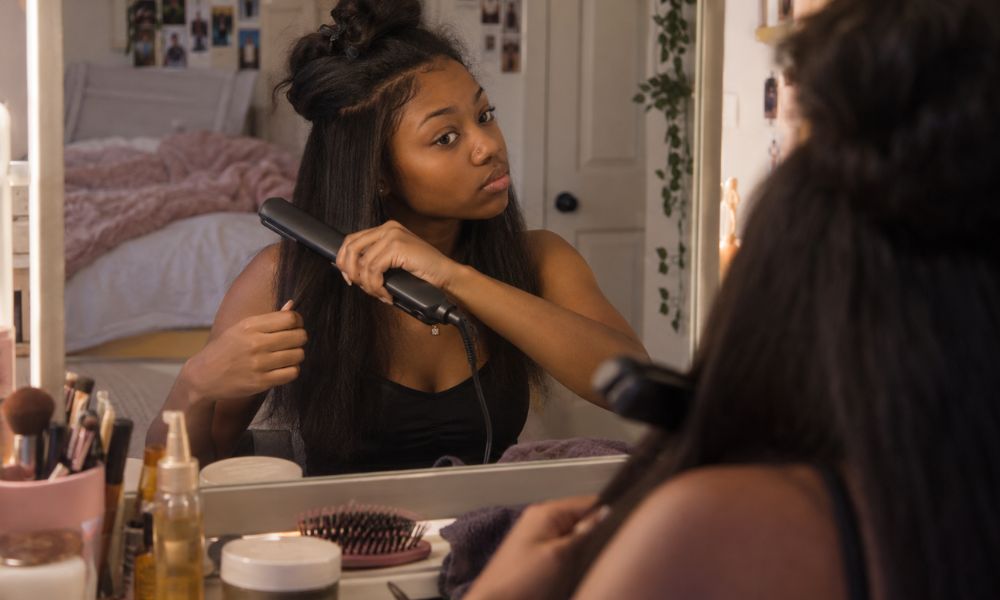
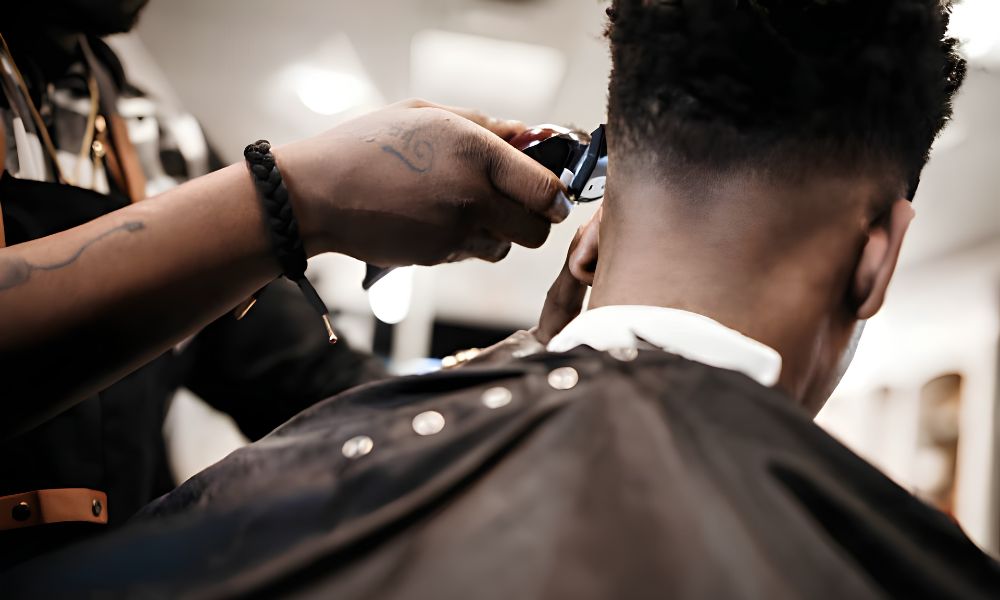
Look at the Black men in your life. Their hair grows thick, coiled and healthy, largely left alone.
Then look at your own hairline, or what’s left of it.
Something in you knows the comparison isn’t fair. You make it anyway.
It’s not that Black men were given better hair. Genetically, we start from the same place. The difference isn’t in what we were born with. It’s in what happened next—and in how Black hair beauty standards have shaped the way women and men are taught to treat their natural hair.
Prefer to listen? Hit play below.
Most Black men wash their hair, cut it and maybe oil it. The ones who cornrow it or loc it do so as a style—an expression, never a correction.
Either way, the relationship is simple. Uncomplicated.
Most Black women have a longer story.
Relaxers from childhood. Hot combs before that, for some of us. Weaves, wigs and braids pulled tight enough to leave headaches and receding hairlines as souvenirs.
Somewhere along the way, a straight, loose and “manageable” texture became the unspoken standard, while our natural hair became the thing to manage away.
I’m not writing this to make anyone feel foolish for the choices they made. I’ve made plenty of my own.
This isn’t a lecture.
It’s a noticing.
“This is just the latest style,” you tell yourself, thumbing through a magazine for the next look to ask for.
The girls with the straightest, sleekest hairstyles always seemed to get noticed. They got the boys’ attention.
And maybe that’s true.
Or maybe there’s something underneath it that’s harder to say out loud: somewhere, a long time ago, you learned that the hair you were born with wasn’t the hair that got chosen.
That belief didn’t come from nowhere. It has a history.
The idea that straight hair is neat and kinky hair is unruly. That a weave looks “finished” in a way an afro doesn’t. That our natural hairline is somehow less presentable than a slicked edge.
All of it traces back to a beauty standard that was never built with us in mind.
We didn’t invent the hierarchy. We inherited it, and most of us inherited it so early that we mistook it for our own opinion.
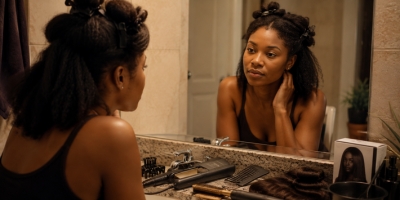
So, we reached for the tools that promised to close the gap.
Chemicals that broke down the structure of the hair to make it lie flat. Heat applied weekly, sometimes daily, to keep it that way. Extensions sewn or glued in tightly enough to change the shape of a hairline permanently.
None of it was stupidity.
It was survival, in its own way, dressed up as style.
But survival has a cost. For many of us, that cost has been paid in follicles that no longer grow, edges that never returned and a texture we now have to search through old photographs to remember.
Meanwhile, the men around us kept their hair mostly untouched, and it thrived.
Not because they were braver, more accepting or more “natural.”
Mostly because nobody built an industry around telling them their hair was wrong.
I grew up in a Rasta household. Both of my parents were Rastafarian.
My mother never wore makeup—not once, not for anything.
If anyone was going to raise a daughter who was immune to all of this, it should have been her.
And still, somewhere along the way, I ended up mixing my first Dark and Lovely relaxer kit at the bathroom sink. Years later, I found myself asking for a weave.
This isn’t a story about weak-minded women who didn’t know better.
I was raised by a woman who rejected the entire apparatus of Eurocentric beauty on principle, and even that wasn’t enough to protect me from it.
That’s how strong the pull is.
It doesn’t need you to be uninformed. It just needs you to be young and surrounded.
I think about that younger version of myself.
The girl who stood in the bathroom mixing the cream from her first relaxer kit, hoping it would make her hair straighter, smoother and more like the hair she saw praised on television and in magazines.
I don’t feel angry at her.
I feel something closer to tenderness, and a quiet kind of grief for what she didn’t know yet.
She was young. She was doing what everyone around her seemed to be doing. She had no way of knowing what twenty years of it would cost.
There’s regret in this, if I’m honest.
But there’s also acceptance.
The pressure to fit a standard that wasn’t built for us is real, and it is strongest when we are young—when we are least equipped to question it.
I don’t think there is much use in punishing ourselves for falling in line with something that surrounded us from every direction.
What I do think is worth doing is looking clearly at what happened, without flinching and without making excuses, so that we can understand it properly.
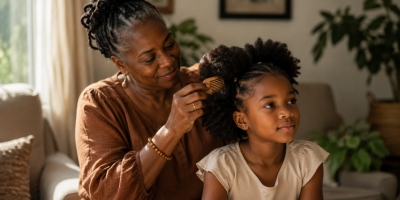
Maybe, for those of us who feel strong enough, there is something else worth doing.
Not a grand gesture.
Just a little more care with the Black girls coming up behind us.
A little less pressure passed down without us noticing that we are passing it.
A little more room for them to grow up believing that their hair, in whatever state it is in, was never the problem.
Whatever your hair looks like right now, and however it got that way, it doesn’t take away from who you are.
That’s not a slogan.
It’s simply true.
If any of this feels familiar, the Afro Woman Collection was made with exactly this kind of recognition in mind.
It’s not about fixing anything.
It’s about wearing something that reflects the parts of you that were never broken to begin with.
You can find the collection at Samanthia Clarke.
Before you close this, you might want to sit with a notebook for ten minutes.
Not to solve anything.
Just to write down whatever comes up.
Sometimes the writing tells you things you didn’t know you were carrying.
The first time I remember believing my natural hair needed fixing was…
The first relaxer kit I ever mixed myself was…
Making peace with what has already happened to my hair would mean…
The young girl I feel most able to protect from this pressure is…
The moment I want to start believing my hair was never the problem is…