
Looking expensive has always been a game of split-second judgments. The nails tap the card reader. One, two, three. Long stilettos, a French tip set with tiny diamantes that catch the light. The cashier’s eyes drop to them, move to the hoops, then come back up to your face. It takes less than a second. You have been appraised, and you have not said a word.
You pay. You take your bag. Somewhere between the till and the door, the thought arrives, uninvited and well rehearsed: Was that too much? Too loud for a Tuesday afternoon?
You already know the answer you were trained to give. You just never agreed to the question.

That glance ran deeper than the manicure.
Long nails. Gold hoops. Slicked edges and baby hairs. Bold lip liner. Plaits stacked with beads. On some women, observers dismiss these details as cheap or loud. Then a fashion house sends the same hoops down a runway, and the caption calls them statement jewelry. A celebrity wears baby hairs on a magazine cover and receives credit for street style. The look stays identical. The only change is who is standing in it.
Think of how many women stand at a mirror before work and take something off. One ring, then the second. Nails filed down before the week of a big presentation. Is this what professional looks like, or simply what safe looks like? Only one of those questions ever gets asked out loud.
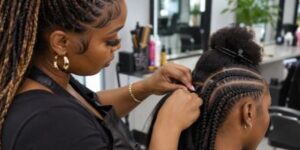
This tradition spans continents. Walk through Harlesden, Lagos, Port of Spain, Accra, or Birmingham on a Saturday, and you see the same skilled craft everywhere. The nail tech in Harlesden who built a business on hand-painted detail. The aunt who leaves the house in her gold because it serves as adornment and family inheritance together. The gele tied with architectural balance. Plaits and cornrows shaped with a geometry that took six hours of focused labor, carrying forward the legacy of Black hair and beauty standards passed down through generations.
That habit of treating the body as an art form crossed oceans with the women who carried it. It never needed external approval. Even so, women across the diaspora have been told in dozens of accents that their style reads as cheap, a discrimination so widespread that the Equality and Human Rights Commission has issued formal guidance to schools and employers to protect natural hair and protective hairstyles. The standard shifts whenever someone thinner, lighter, or wealthier wears the same piece.
Watch the route a look travels. First, women wear it for joy, community, and personal polish. Then outsiders mock it. Administrators write it into school dress codes. Managers bring it up during performance reviews. A colleague calls it “a bit much.”
Later, someone from an elite postcode wears it, and the look gets renamed. It gains a French label and a price tag with an extra zero. The women who kept the style alive while paying a social penalty for it stay shut out. Nobody sends credit to the nail tech in Harlesden who spent years refining that shape.

The ongoing tension between Black beauty and Eurocentric beauty standards shows how these rules measured proximity to whiteness, turning “expensive” into a polite label for smaller, quieter, paler, straighter, less.
Looking expensive meant looking like you belonged to the people who owned the building. Money only covers part of that equation. A Black woman can present the store receipt and still be labeled cheap. A white woman in a second-hand jumper gets praised as effortless.
Social class works the same way. Working people face criticism for the styles they enjoy, while people with social capital wear identical items without needing an explanation. Same hoops. Same gold. Same careful application. The only difference is social permission.
When you stop to ask who defines your beauty, you realize that if the definition of taste shifts based on who wears the look, the styling itself was never the problem. The nails worked fine at the card reader. They worked fine in the elevator. Sit with that contrast for a moment. Pay attention to who gets labeled luxurious and who gets dismissed as excessive.

Some women have decided to stop auditioning for outside approval. The Afro Woman Collection hoodies, jumpers, t-shirts, and affirmation mugs were made for days when you step out as yourself without footnotes. You can view the pieces at Samanthia Clarke Shop.
Writing offers a practical way to examine thoughts that need room to settle. Take a notebook and finish these prompts: